Eval
Agents eval:
- Start early.
- Source realistic tasks from failures.
- Define unambiguous, robust success criteria.
- Design graders thoughtfully and combine multiple types (code-based, model-based, human).
- Make sure the problems are hard enough for model.
- Iterate on evaluations to improve signal-to-noise ratio.
- Read transcripts (记录).
- Pick framework: prompt foo, harbor.
| Method | 👍 Strengths | 👎 Weaknesses |
|---|---|---|
| Human Evaluation | Captures nuanced behavior | Subjective, time-consuming, expensive, difficult to scale |
| LLM-as-a-Judge | Consistent, scalable, efficient | May overlook intermediate steps, limited by LLM capabilities |
| Automated Metrics | Objective, scalable, efficient | May not capture full capabilities |
Trace
When building agents, trace is the source of truth:
- Debugging becomes trace analysis
- Testing becomes eval-driven
- Can't set breakpoints in reasoning
- Performance optimization changes: task success rate, reasoning quality, tool usage efficiency
Trajectory
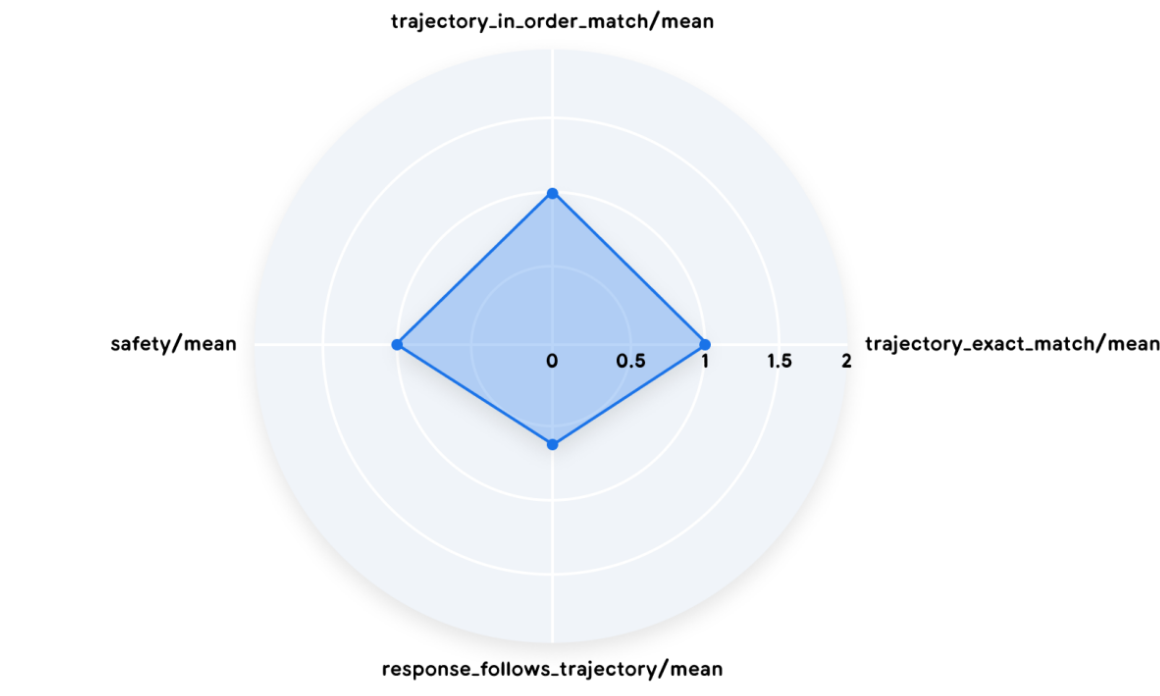
Trajectory is equally important as final response:
- Exact match: produce trajectory that perfectly mirrors ideal solution.
- In-order match: complete expected trajectory, while accommodating extra, un-penalized actions.
- Any-order match: include all necessary actions.
- Precision: relevant tool calls.
- Recall: essential tool calls.
Benchmarks
- Aggregate: Don’t obsess over a 1-2% lead on one benchmark, focus on specific and comprehensive domain.
- Relative: Compare within the same model family or lab, how did the score change from v1 to v2?
- Verify: The only benchmark that matters at the end of the day is your workload.