Concurrent
Concurrent Features
import App from 'App'
import * as ReactDOM from 'react-dom'

// Create a root by using ReactDOM.createRoot():
const root = ReactDOM.createRoot(document.getElementById('app'))

// Render the main <App/> element to the root:
root.render(<App />)
Batching Updates
- All updates will be automatically batched, including updates inside of promises, async code and native event handlers.
ReactDOM.flushSynccan opt-out of automatic batching.
function handleClick() {
  // React 17: Re-rendering happens after both of the states are updated.
  // This is called batching.
  // This is also the default behavior of React 18.
  setIsBirthday(b => !b)
  setAge(a => a + 1)
}

// For the following code blocks,
// React 18 does automatic batching, but React 17 doesn't.
// 1. Promises:
function handleClick() {
  fetchSomething().then(() => {
    setIsBirthday(b => !b)
    setAge(a => a + 1)
  })
}

// 2. Async code:
setInterval(() => {
  setIsBirthday(b => !b)
  setAge(a => a + 1)
}, 5000)

// 3. Native event handlers:
element.addEventListener('click', () => {
  setIsBirthday(b => !b)
  setAge(a => a + 1)
})
Reconciler 注册调度任务时, 会通过节流与防抖提升调度性能:
- 在 Task 注册完成后, 会设置
FiberRoot的属性, 代表现在已经处于调度进行中. - 再次进入
ensureRootIsScheduled时 (比如连续 2 次setState, 第二次setState同样会触发 Reconciler 与 Scheduler 执行), 如果发现处于调度中, 则会通过节流与防抖, 保证调度性能. - 节流:
existingCallbackPriority === newCallbackPriority, 新旧更新的优先级相同, 则无需注册新 Task, 继续沿用上一个优先级相同的 Task, 直接退出调用. - 防抖:
existingCallbackPriority !== newCallbackPriority, 新旧更新的优先级不同, 则取消旧 Task, 重新注册新 Task.
function ensureRootIsScheduled(root: FiberRoot, currentTime: number) {
  const existingCallbackNode = root.callbackNode
  const nextLanes = getNextLanes(
    root,
    root === workInProgressRoot ? workInProgressRootRenderLanes : NoLanes,
  )

  if (nextLanes === NoLanes) {
    if (existingCallbackNode !== null)
      cancelCallback(existingCallbackNode)

    root.callbackNode = null
    root.callbackPriority = NoLane
    return
  }

  const newCallbackPriority = getHighestPriorityLane(nextLanes)
  const existingCallbackPriority = root.callbackPriority

  // Debounce.
  if (existingCallbackPriority === newCallbackPriority) {
    // The priority hasn't changed. We can reuse the existing task. Exit.
    return
  }

  // Throttle.
  if (existingCallbackNode != null) {
    // Cancel the existing callback. We'll schedule a new one below.
    cancelCallback(existingCallbackNode)
  }

  // Schedule a new callback.
  let newCallbackNode

  if (newCallbackPriority === SyncLane) {
    if (root.tag === LegacyRoot)
      scheduleLegacySyncCallback(performSyncWorkOnRoot.bind(null, root))
    else scheduleSyncCallback(performSyncWorkOnRoot.bind(null, root))

    if (supportsMicroTasks) {
      scheduleMicroTask(() => {
        if (executionContext === NoContext)
          flushSyncCallbacks()
      })
    } else {
      scheduleCallback(ImmediateSchedulerPriority, flushSyncCallbacks)
    }

    newCallbackNode = null
  } else {
    const eventPriority = lanesToEventPriority(nextLanes)
    const schedulerPriorityLevel
      = eventPriorityToSchedulePriority(eventPriority)
    newCallbackNode = scheduleCallback(
      schedulerPriorityLevel,
      performConcurrentWorkOnRoot.bind(null, root),
    )
  }

  root.callbackPriority = newCallbackPriority
  root.callbackNode = newCallbackNode
}
Suspense
Extract loading/skeleton/placeholder components into single place:
export default function App() {
  return (
    <Suspense fallback={<Skeleton />}>
      <Header />
      <Suspense fallback={<ListPlaceholder />}>
        <ListLayout>
          <List pageId={pageId} />
        </ListLayout>
      </Suspense>
    </Suspense>
  )
}
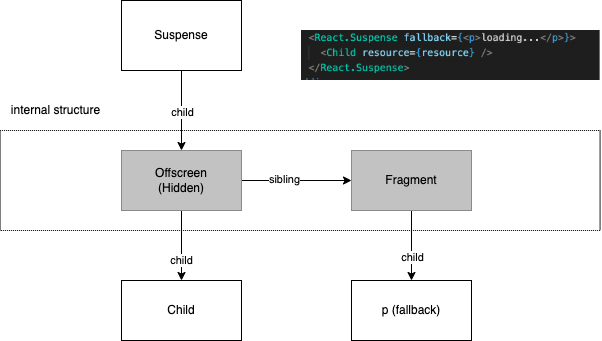
React Bottlenecks
- CPU bottleneck: Concurrency Feature (Priority Interrupt Mechanism).
- I/O bottleneck: Suspense.
Error Boundary Suspense
function ErrorFallback() {
  return (
    <div
      className="text-red-500 w-screen h-screen flex flex-col justify-center items-center"
      role="alert"
    >
      <h2 className="text-lg font-bold">Oops, something went wrong :( </h2>
      <Button
        className="mt-4"
        onClick={() => window.location.assign(window.location.origin)}
      >
        Refresh
      </Button>
    </div>
  )
}

interface AppProviderProps {
  children: React.ReactNode
}

export function AppProvider({ children }: AppProviderProps) {
  return (
    <React.Suspense
      fallback={(
        <div className="h-screen w-screen flex items-center justify-center">
          <Spinner size="xl" />
        </div>
      )}
    >
      <ErrorBoundary FallbackComponent={ErrorFallback}>
        {children}
      </ErrorBoundary>
    </React.Suspense>
  )
}
Lazy Suspense
Lazy loading and code splitting:
import { lazy, Suspense } from 'react'

const Product = lazy(() => import('./ProductHandler'))

export default function App() {
  return (
    <div className="product-list">
      <h1>My Awesome Product</h1>
      <Suspense fallback={<h2>Product list is loading...</h2>}>
        <p>Take a look at my product:</p>
        <section>
          <Product id="PDT-49-232" />
          <Product id="PDT-50-233" />
          <Product id="PDT-51-234" />
        </section>
      </Suspense>
    </div>
  )
}
const { lazy, Suspense } = React

const Lazy = lazy(
  () =>
    new Promise((resolve) => {
      setTimeout(() => {
        resolve({ default: () => <Resource /> })
      }, 4000)
    }),
)

function Resource() {
  return (
    <div className="box">
      <h1>React Lazy</h1>
      <p>
        This component loaded after 4 seconds, using React Lazy and Suspense
      </p>
    </div>
  )
}

export default function App() {
  return (
    <Suspense fallback={<div>Loading...</div>}>
      <Lazy />
    </Suspense>
  )
}

ReactDOM.createRoot(document.getElementById('root')).render(<App />)
function createModuleLoader(load) {
  return {
    module: null,
    promise: null,
    error: null,
    load() {
      if (this.module != null) {
        return this.module
      }

      if (this.error != null) {
        throw this.error
      }

      if (this.promise == null) {
        this.promise = load().then((res) => {
          // suppose we get an ES module
          this.module = res.default
        }, (error) => {
          this.error = error
        })
      }

      throw this.promise
    }
  }
}

function lazy(load) {
  const moduleLoader = createModuleLoader(load)
  return function (props) {
    const Component = moduleLoader.load()
    return <Component {...props} />
  }
}
SSR Suspense
React v18+: enable Suspense on the server:
- Selective Hydration: one slow part doesn't slow down whole page.
- Streaming HTML: show initial HTML early and stream the rest HTML.
- Enable code splitting for SSR.
export default function LandingPage() {
  return (
    <div>
      <FastComponent />
      <Suspense fallback={<Spinner />}>
        <Comments />
      </Suspense>
    </div>
  )
}
- Suspense is serialized by comment node with
<!--$-->meaning non-suspended, and<!--$!-->as suspended. - Hydration for Suspense is 2-pass process in order to put it into lower priority.
- During hydration:
- If pre-existing DOM is fallback, then it'll be discarded and client-side rendering will generate the new DOM, either fallback or contents.
- If pre-existing DOM is contents, but client-side suspends. We want to switch the contents directly without fallback in the middle, so fallback won't be displayed.
- If pre-existing DOM is contents and also is the client-side, then hydration continues to the children of Suspense.
import * as React from 'react'
import './style.css'

function createCounter(delay) {
  return {
    data: null,
    promise: null,
    fetch() {
      if (this.data != null) {
        return this.data
      }

      if (this.promise == null) {
        this.promise = new Promise((resolve) => {
          setTimeout(() => {
            this.data = delay
            resolve(this.data)
          }, delay)
        })
      }
      throw this.promise
    },
  }
}

const counter1000 = createCounter(1000)
const counter2000 = createCounter(2000)

function Component({ counter }) {
  const count = counter.fetch()
  return (<button type="button">{count}</button>)
}

function render(jsx, context) {
  if (jsx == null) {
    return ''
  }

  if (typeof jsx === 'string' || typeof jsx === 'number') {
    return jsx
  }

  if (typeof jsx.type === 'string') {
    return `<${jsx.type}>${render(jsx.props.children, context)}</${jsx.type}>`
  }

  if (Array.isArray(jsx)) {
    return jsx.map(item => render(item, context)).join('')
  }

  if (typeof jsx.type === 'function') {
    return render(jsx.type(jsx.props), context)
  }

  if (jsx.type === Symbol.for('react.suspense')) {
    try {
      return `<div hidden id="S:${context.id}">${render(
        jsx.props.children,
        context
      )}</div><script>TODO: some script to kick off the re-render of target suspense boundary</script>`
    } catch (e) {
      if ('then' in e) {
        const currentContext = { ...context }
        e.then(() => {
          context.pipe(render(jsx, currentContext))
        })

        return `<!--$?--><template id="B:${context.id++}"></template>${render(
          jsx.props.fallback,
          context
        )}<!--/$-->`
      } else {
        throw new Error(`error in rendering:${e}`)
      }
    }
  }
  throw new Error(`unhandled type${jsx.type}`)
}

function renderToPipe(jsx, pipe) {
  pipe(
    render(jsx, {
      pipe,
      id: 0, // increment id to differentiate suspense boundaries.
    })
  )
}

export default function App() {
  const [chunks, setChunks] = React.useState([])

  const pipe = React.useCallback((chunk) => {
    console.log('pipe', chunk)
    setChunks(chunks => [...chunks, chunk])
  }, [])

  React.useEffect(() => {
    const jsx = (
      <div>
        <React.Suspense fallback="loading">
          <Component counter={counter1000} />
        </React.Suspense>
        <React.Suspense fallback="loading">
          <Component counter={counter2000} />
        </React.Suspense>
        <p>another p</p>
      </div>
    )
    renderToPipe(jsx, pipe)
  }, [pipe])

  return (
    <div>
      {chunks.map((chunk, i) => (
        <div key={chunk.id}>
          <p>
            chunk
            {i + 1}
          </p>
          <code>{chunk}</code>
          <hr />
        </div>
      ))}
    </div>
  )
}